
The Obstacle to Progress: How Article 34 Stops Housing
Examining the constitutional barrier that limits housing options and equity for residents across San Mateo County.
The Challenge: An Outdated Barrier
Article 34 acts as a constitutional barrier to creating affordable housing in several ways:
Makes it harder to preserve existing affordable home supply.
Article 34 can impede a public agency’s ability to acquire existing buildings for use as affordable housing stock. This increases the odds of displacing vulnerable low income residents, and delays housing opportunities for our county’s families, workers, elderly disabled, veterans and other members of our communities.
Concentrates affordable housing in fewer neighborhoods.
Because Article 34 requires voter approval for publicly funded affordable housing, cities may avoid proposing affordable housing opportunities in areas where neighborhood opposition is more likely, undermining more balanced access to housing opportunities across our communities.
Discourages 100% affordable projects even when public funds are available.
It pressures cities to fund mixed-income projects with higher-income units just to avoid triggering an election, making it harder to create fully affordable housing.
Adds delay, cost, and uncertainty which can derail affordable housing projects.
Elections take time, outcomes are unpredictable, and construction costs will rise while projects languish and local affordable housing needs continue to go unmet.
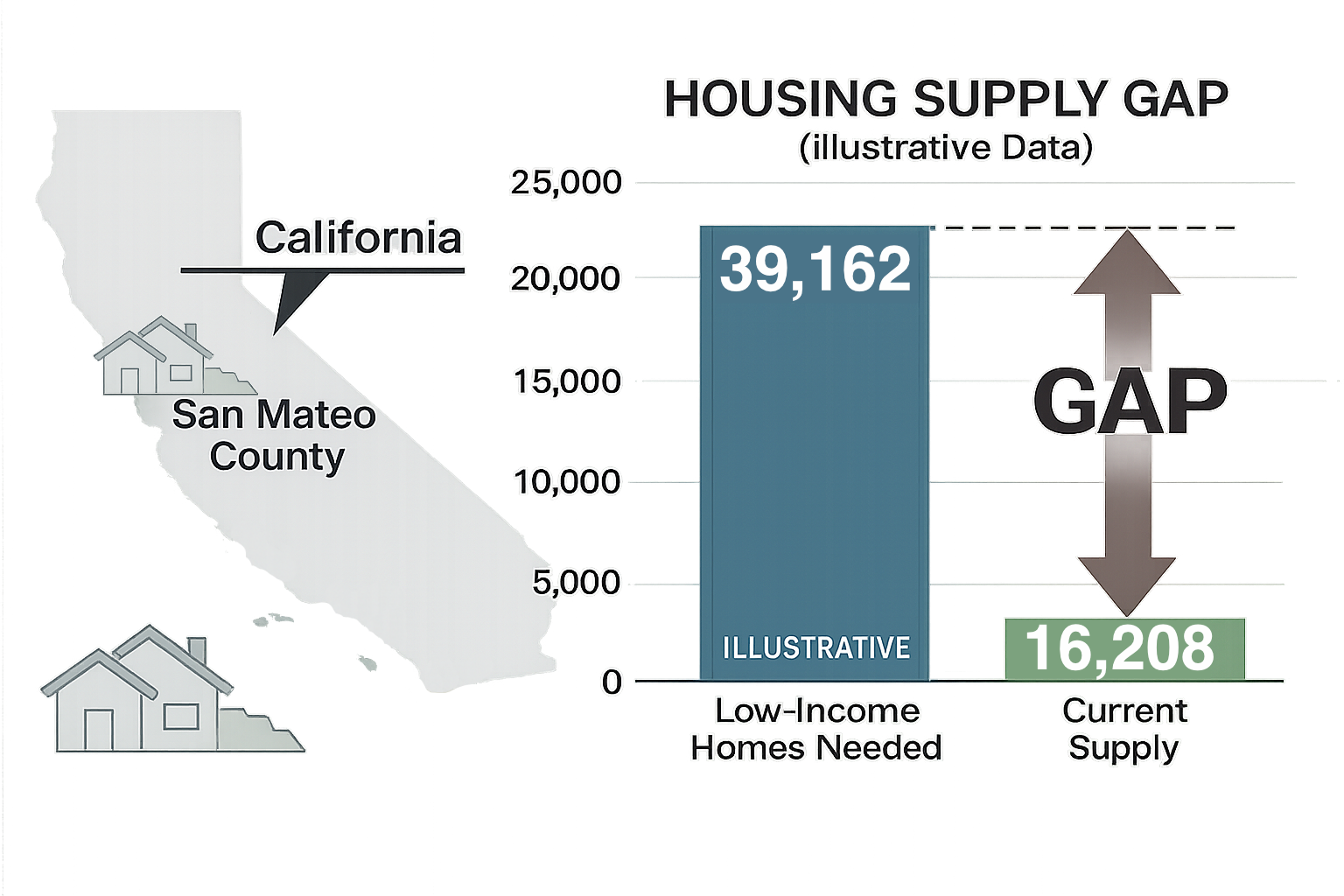
The Current Need in San Mateo County
- The gap in need versus supply is 22,954 low-income homes.
- 81% of extremely low-income households in the County spend more than half of their income on housing.
- The 2024 point-in-time count found 2,130 people experiencing homelessness.
The Solution: An Article 34 Ballot Measure in San Mateo County
A ballot measure would ask San Mateo County voters to eliminate the Article 34 roadblock of putting each publicly funded affordable housing project before voters separately. In addition, it would allow voters to pre-approve a set number of affordable housing units (up to 1% of existing housing units in the County), to be acquired or developed by a public agency.
Cities and Counties across California have passed similar ballot measures to clear this affordable housing barrier. They include:
- San Francisco
- Oakland
- Berkeley
- South San Francisco
- Los Angeles
- San Diego
- Sacramento County
- Santa Clara County

Frequently Asked Questions
If an Article 34 ballot measure is passed, will cities lose local control over housing decisions?
No. An Article 34 ballot measure would only eliminate the voter-approval requirement that currently applies to low-income publicly funded housing, while leaving cities’ standard land use control intact including current zoning, general plans, etc.
Why remove the voters’ right to approve or reject publicly each funded housing project?
An Article 34 ballot measure asks voters to support the idea of public agencies purchasing and preserving existing buildings for affordable housing without requiring an election for each one. This does not eliminate the standard process of community outreach, public hearings, and standard local land use processes.
Does Article 34 ensure affordable housing is distributed fairly across all neighborhoods?
Yes. Article 34 is a voter-approval requirement for certain low-income housing projects, but it does not determine where affordable housing is planned or built. Those decisions are made per zoning and Housing Element processes, which requires jurisdictions to identify, and/or rezone sites that can realistically accommodate affordable housing.
Will affordable housing take properties off the tax rolls and hurt city services?
If a public agency purchases an existing property to create affordable housing, that property will no longer be subject to ad valorem tax. For example, if a public agency were to purchase a property assessed at $5 million, the city would forfeit approximately $10,000 in annual taxes. Such a loss represents a small portion of a city’s overall tax base. The nominal lost property taxes are an investment in our communities, reducing the public cost of housing instability and homelessness.
An Urban Institute cost analysis of supportive housing in Denver found that over half of supportive housing costs were offset by reductions in other public services, including avoided jail days, ambulance rides, and emergency department visits. Passing an Article 34 ballot measure can ultimately reduce the funding strain on public services, outweighing any marginal property tax loss related to creating affordable housing.
If an Article 34 ballot measure is approved, how will the County of San Mateo allocate the units?
If a developer wishes to utilize units from the Article 34 bank of units authorized by the measure, the developer will notify the County. The County will review the request and allocate unites to the project if appropriate. Units will be allocated on a first-come, first-served basis.
Get Informed
Stay informed about Article 34 and how our communities can do better at providing affordable housing for ALL San Mateo County residents.
What exactly is Article 34?
Article 34 emerged as a statewide ballot initiative in 1950. It was designed to block affordable housing and exclude people of color and low-income families from certain neighborhoods. It passed narrowly (50.8% to 49.2%), formalizing a voter-approval requirement for low-rent housing projects in the state constitution.
California is the only state with this kind of restriction. No other state requires a public vote as a prerequisite to creating publicly funded affordable housing.